
Codiga
Codiga is an AI-powered coding assistant and static analysis platform that helps developers write cleaner, more secure code. It offers real-time code reviews, automated quality checks, and reusable code snippets across many languages and IDEs. Codiga improves consistency, catches issues early, and boosts team productivity.
Face
Introduction
Codiga is a powerful software quality platform powered by AI that focuses on static code analysis and automated review. It works directly with your codebase to provide immediate feedback and assist developers in writing secure, consistent, and maintainable code without the need for extensive manual review. Codiga detects issues such as bugs, coding standard violations, vulnerabilities, and bad practices early in the development process. :contentReference[oaicite:1]{index=1}
About
Codiga leverages advanced algorithms and predefined rule sets to analyze source code across more than a dozen programming languages and frameworks. It supports popular repository platforms like GitHub, GitLab, and Bitbucket, allowing developers to connect projects and automate quality checks on every commit or pull request. The tool’s static analysis engine continually updates its rules, helping teams catch both common and subtle issues. :contentReference[oaicite:2]{index=2}
Work
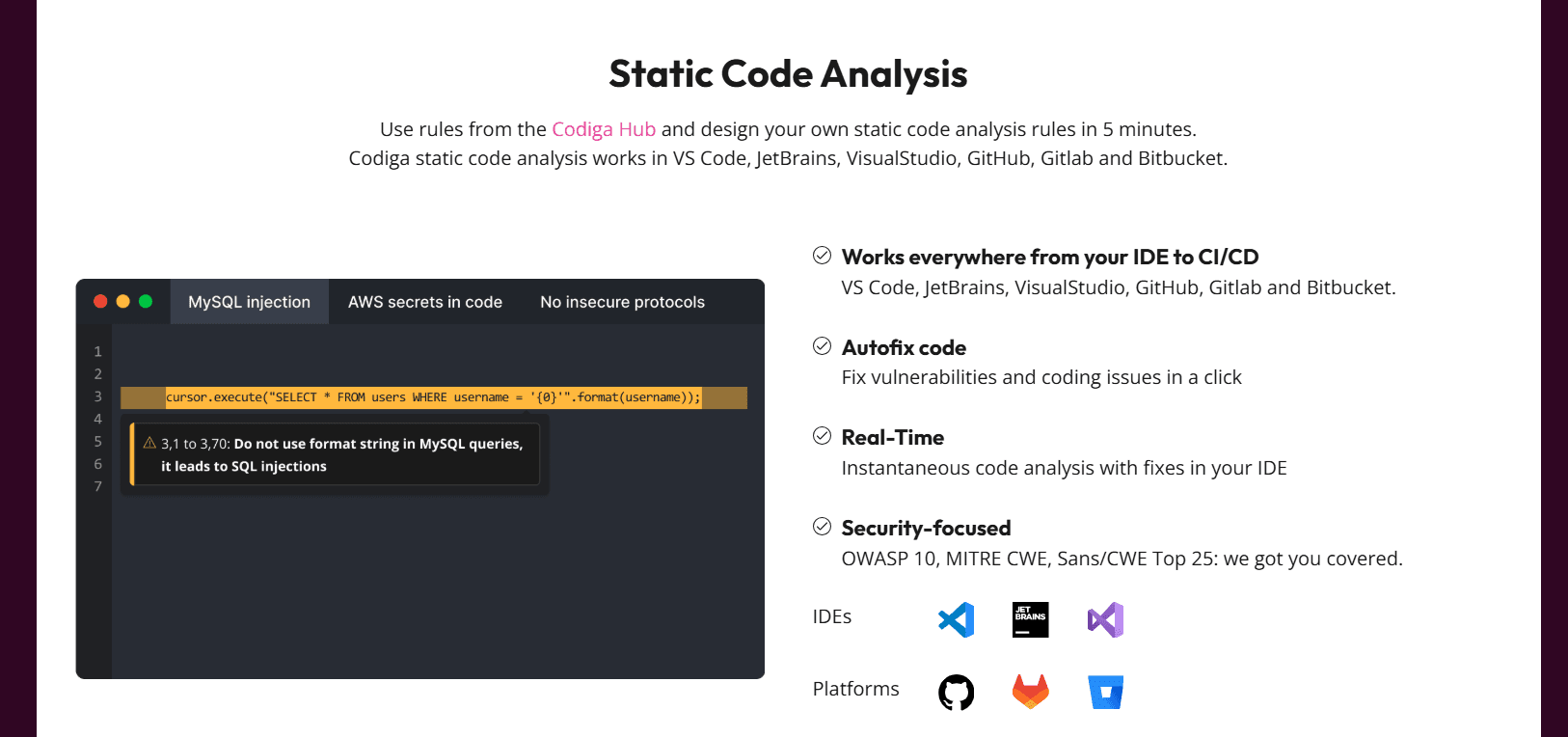
Once integrated with your repository or IDE, Codiga scans your code in real time or during pull requests. It highlights security problems, coding standard violations, performance issues, and more. Developers receive feedback automatically without waiting for manual review cycles, making the development process faster and more efficient. Teams can also define custom static analysis rules to enforce specific project standards. :contentReference[oaicite:3]{index=3}
Key Features
Check out my core capabilities below:
Limitations
While Codiga offers rich analysis and review automation, its real-time static analysis can be resource-intensive on very large codebases. Some advanced features, particularly around deep security scanning and analytics, may only be available in paid plans and may have a learning curve during initial setup. :contentReference[oaicite:4]{index=4}
Where Used
Codiga is commonly used in continuous integration and delivery workflows, automated pull request checks, quality gates, and developer workflows where automated code feedback improves efficiency. It is ideal for engineering teams looking to maintain consistent standards across complex projects. :contentReference[oaicite:5]{index=5}
Pros and Cons
Every tool has its strengths and weaknesses:
Strengths
- ✓ Automates manual code reviews and saves developer time
- ✓ Provides real-time feedback and insights within IDE and PR workflows
- ✓ Supports a broad range of languages and rulesets
- ✓ Customizable analysis rules tailored to team standards
- ✓ Improves security by detecting vulnerabilities and leaks
Weakness
- ✕ Free plan may be limited for larger teams
- ✕ Advanced features may require paid subscription
- ✕ Real-time analysis can be heavier on large codebases
- ✕ Focuses on quality and scanning, not code generation
Future
Codiga continues to evolve with improvements in rule coverage, language support, and integration capabilities. Ongoing updates aim to enhance user experience, provide richer analytics dashboards, and extend support for more CI/CD pipelines and repository technologies. Enhanced customization for enterprise needs is also expected. :contentReference[oaicite:6]{index=6}
Challenges
Some of the main challenges include keeping up with rapidly changing language ecosystems, balancing real-time analysis with performance on large codebases, and making advanced quality insights accessible to developers without overwhelming them. Providing seamless collaboration features across distributed teams also remains a key focus area. :contentReference[oaicite:7]{index=7}
Conclusion
Codiga is a comprehensive AI-powered code quality and review platform that helps developers catch issues faster, enforce coding standards, and improve overall software quality. Its integration with IDEs and popular version control systems makes it a practical choice for teams seeking scalable, automated code analysis workflows. :contentReference[oaicite:8]{index=8}