
OpenAI Codex
OpenAI Codex is an AI-powered coding assistant and software engineering agent developed by OpenAI that understands natural language and generates or edits code, fixes bugs, and handles development tasks in cloud or local environments. It helps programmers work faster by automating repetitive tasks, refactoring, testing, and code review.
Face
Introduction
OpenAI Codex is an advanced AI engineering assistant that helps developers translate human language into runnable code. It goes beyond simple code completion, enabling you to instruct it to perform complete tasks such as building features, fixing bugs, running tests, and proposing pull requests without manually writing every line of code.
About
Built by OpenAI and powered by specialized models like codex-1 and GPT-5-Codex, Codex is trained on vast amounts of source code and programming tasks. It understands context from your project files and natural language instructions, making it capable of handling diverse software engineering needs from simple scripting to complex refactoring.
Work
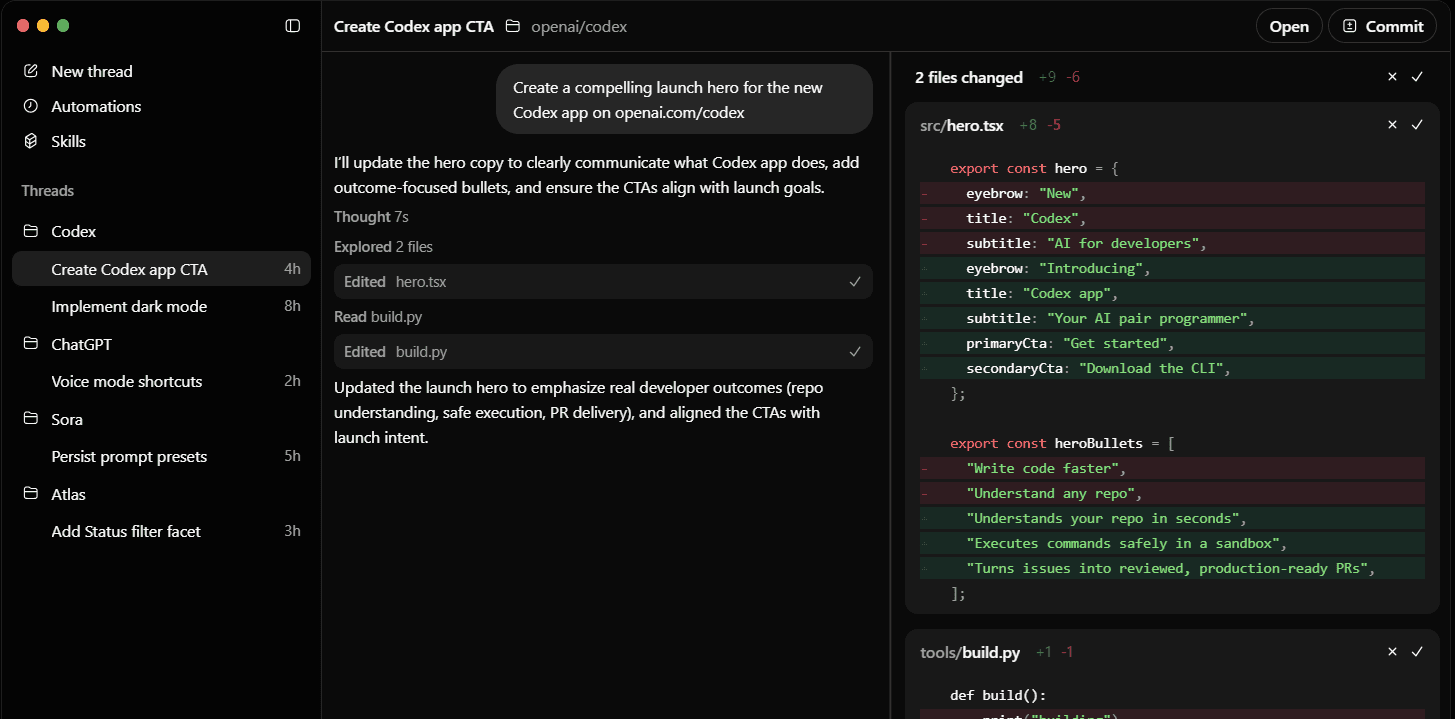
Developers interact with Codex through natural language prompts — for example, describing what they want to build. Codex then reads the relevant codebase, generates code, runs tests, and returns results that help validate each step. It can operate in an isolated sandbox, ensuring safe execution, and can be used from interfaces such as IDE extensions, CLI tools, or the Codex app.
Key Features
Check out my core capabilities below:
Limitations
Despite its strength, Codex still requires human oversight. Output may need review, and long or context-heavy tasks can take time to complete. Additionally, full access requires subscription plans, and some complex project customizations require manual configuration.
Where Used
Codex is used across software development workflows, including feature implementation, bug fixing, automated testing, code review, CI/CD pipelines, and engineering automation. Its ability to take directives in plain language makes it useful from individual scripting to team-wide engineering tasks.
Pros and Cons
Every tool has its strengths and weaknesses:
Strengths
- ✓ Can automate repetitive or long development tasks
- ✓ Reads and edits full codebases with context
- ✓ Supports a wide range of languages and environments
- ✓ Runs code tests and validates changes automatically
- ✓ Improves developer productivity across teams
Weakness
- ✕ Requires subscription for full access (Plus/Pro/Business/Enterprise)
- ✕ Takes time for complex or multi-step tasks
- ✕ Generated output still needs human review
- ✕ May need configuration to match specific project standards
- ✕ Not a full replacement for experienced developers
Future
OpenAI continues to invest in Codex with improved models like GPT-5-Codex and agentic features. Future enhancements aim to increase autonomy, improve understanding of large codebases, support richer natural language interactions, and integrate deeper with popular developer tools.
Challenges
One of the biggest challenges for Codex is balancing powerful autonomous execution with safety and correctness. Ensuring generated code is secure, efficient, and understandable remains critically important, and the tool requires clear guidance and review by developers.
Conclusion
OpenAI Codex represents a significant step forward in AI-assisted software engineering. By automating routine coding tasks, providing context-aware solutions, and bridging natural language with actual code, it increases productivity and allows developers to focus on higher-level design and problem solving.